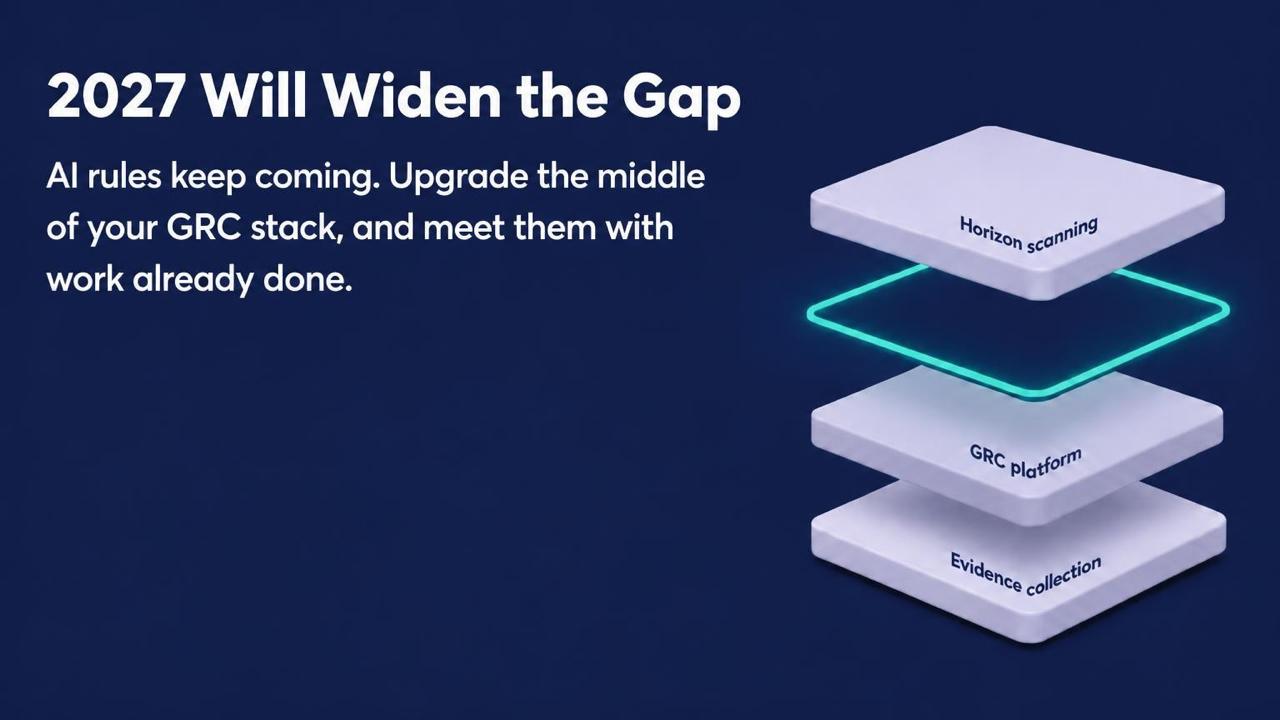
Most teams are missing at least one of the four parts.
Your team is already behind on regulatory change. In 2027, the gap gets wider.
More AI regulations and standards are on the way, and some are already in force. Each one touches frameworks you already follow. Every new document means the same job. Read it. Break it down. Work out which controls it needs. Check those controls against your existing controls and policies.
You know a lot of what these new rules ask for, you already do. Access control. Data governance. Change management. Vendor oversight. The words are new. The controls behind them are not. The trouble is seeing the overlap.
You can’t expect your GRC platform to handle that. It wasn’t designed to. It won’t tell you which controls overlap across your frameworks. And it won’t trace each control back to the exact text that demands it.
That work happens one step earlier, in a part of the stack most teams are missing. Here’s the whole stack, so you can see where it fits.
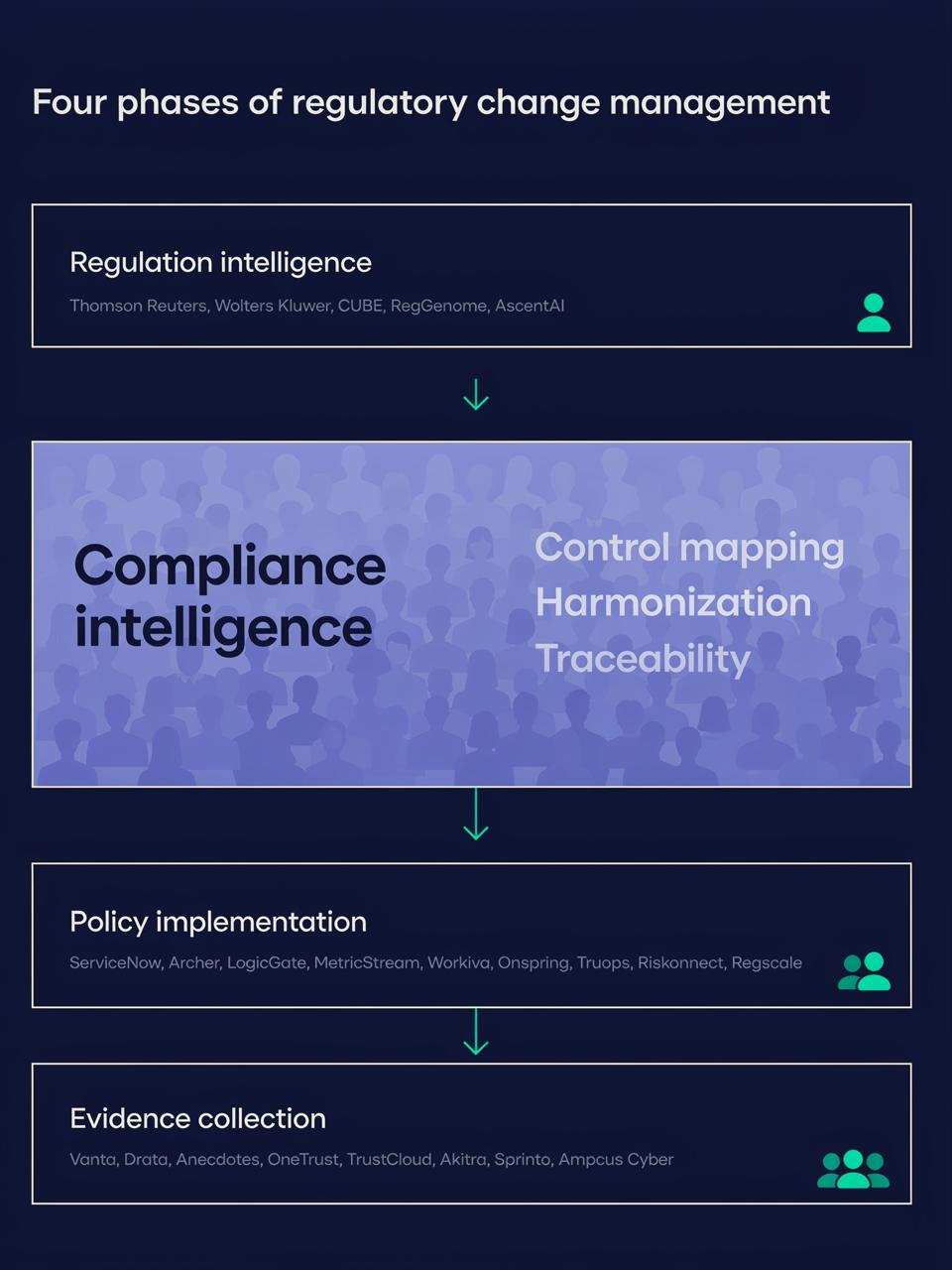
Most teams have tools for three of these four phases. The one in the middle is where the hours go.
Regulation intelligence tells you what's coming
This is the first phase, and it's well served. Thomson Reuters, Wolters Kluwer, CUBE, and others have tracked regulations and standards for years.
They scan for new rules and tell you which ones might matter to you. If you want to know what's coming, you have plenty of choices.
Your GRC platform runs the workflow
You almost certainly own one already. ServiceNow, Archer, LogicGate, MetricStream, Workiva, Onspring, and the rest.
This is where you assign work, track sign-off, and keep the record. It's the system your auditors expect to see.
The trouble is, GRC platforms start out empty. You have to fill them with the controls that apply to your business. That's the hardest part of getting your GRC program under way.
That's why the leading GRC platform vendors partner with us. It lets customers like you fill your platform from our system, with the controls that matter.
Evidence collection is growing fast
This is the newest phase, and it has grown quickly. Vanta, Drata, and others connect to your systems and gather proof that your controls work.
It has grown so fast that the leading tools are now hard to tell apart. GRC platforms and evidence collection are converging. You have plenty of choice here too.
The messy middle is where your time is lost
Now look at the box in the middle. Turning regulations and standards into controls and policies is three jobs in one. And each one gets harder the more frameworks you carry.
Control mapping. Work out which controls each requirement demands.
Harmonization. Spot when different documents ask for the same control in different words.
Traceability. Tie every control back to the exact text that demands it, so you can show an auditor why it's there.
It's painstaking work, and it ties up your most experienced people for weeks at a time. Then a regulation changes, or a new one comes out, and you're doing it all over again.
This is also where AI rules hurt most. Every new AI standard has to go through this middle box. And without harmonization, you can't see how much of it you already cover.
What about AI tools?
Your choices here are thin. A few vendors now use AI to map new rules to a control library.
But whose library? Usually yours, the one your team built by hand.
If that library is out of date, or can’t trace each control back to its source, the AI won’t fix that. It just gets you to the wrong answer faster.
Someone has already built the library
Most teams don’t know they can subscribe to compliance intelligence, instead of digging through documents to pull it out for themselves.
Unified Compliance has spent 20 years reading regulations and standards and breaking them down into harmonized controls, so you don't have to. That's more than 4,100 regulations and standards, mapped to 15,000 common controls, backed by 19 patents.
Every control traces back to the exact text of the requirement that demands it.
We're not a GRC platform. We fill your GRC platform with the controls that make it useful.
How work changes with the middle piece in place
Tell ControlSight which regulations and standards apply to you, and it shows you the controls you need.
Add another regulation, and you instantly see how much of it is already on your control list. Only the few controls that are new get added.
Now with ControlFoundry, you can even weave in your own policies and link them to all of those controls. So, you can see which controls are covered and which have no policy behind them.
Get ahead of 2027
More AI regulations and standards are on the way, and they won't wait for your team to catch up.
If you have budget left this year, think about where it does the most good. You likely have scanning. You have a GRC platform. You may have evidence tools. The gap is the middle.
Fill it now, and you'll meet the next wave of rules with work already done, instead of falling further behind.
See how fast your team could handle the next new rule. Book a demo.